
Toyota CH-R Owners Manual: If your vehicle overheats
The following may indicate that your vehicle is overheating.
- The needle of the engine coolant temperature gauge enters the red zone or a loss of engine power is experienced (for example, the vehicle speed does not increase).
- Steam comes out from under the hood.
Correction procedures
1. Stop the vehicle in a safe place and turn off the air conditioning system, and then stop the engine.
2. If you see steam: Carefully lift the hood after the steam subsides.
If you do not see steam: Carefully lift the hood.
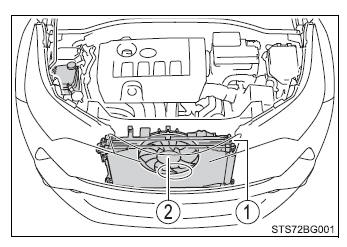
3. After the engine has cooled down sufficiently, inspect the hoses and radiator core (radiator) for any leaks.
- Radiator
- Cooling fan
If a large amount of coolant leaks, immediately contact your Toyota dealer.
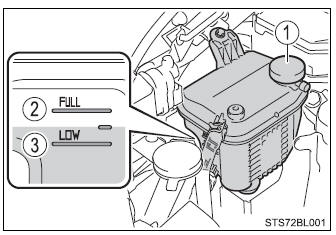
4. The coolant level is satisfactory if it is between the "FULL" and "LOW" lines on the reservoir.
- Reservoir
- "FULL" line
- "LOW" line
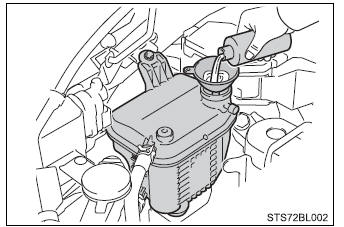
5. Add coolant if necessary.
Water can be used in an emergency if coolant is unavailable.
6. Start the engine and turn the air conditioning system on to check that the radiator cooling fan operates and to check for coolant leaks from the radiator or hoses.
The fan operates when the air conditioning system is turned on immediately after a cold start. Confirm that the fan is operating by checking the fan sound and air flow. If it is difficult to check these, turn the air conditioning system on and off repeatedly.
(The fan may not operate in freezing temperatures.)
7. If the fan is not operating: Stop the engine immediately and contact your Toyota dealer.
If the fan is operating: Have the vehicle inspected at the nearest Toyota dealer.
■When inspecting under the hood of your vehicle Observe the following precautions.
Failure to do so may result in serious injury such as burns.
- If steam is seen coming from under the hood, do not open the hood until the steam has subsided. The engine compartment may be very hot.
- Keep hands and clothing (especially a tie, a scarf or a muffler) away from the fan and belts. Failure to do so may cause the hands or clothing to be caught, resulting in serious injury.
- Do not loosen the coolant reservoir cap while the engine and radiator
are hot.
High temperature steam or coolant could spray out.
■When adding coolant Add coolant slowly after the engine has cooled down sufficiently. Adding cool coolant to a hot engine too quickly can cause damage to the engine.
■To prevent damage to the cooling system Observe the following precautions:
- Avoid contaminating the coolant with foreign matter (such as sand or dust etc.).
- Do not use any coolant additives.
 If the vehicle battery is discharged
The following procedures may be used to start the engine if the vehicle's
battery is discharged.
You can also call your Toyota dealer or a qualified repair shop.
If you have a set of jumper ...
 If the vehicle becomes stuck
Carry out the following procedures if the tires spin or the vehicle
becomes stuck in mud, dirt or snow:
Stop the engine. Shift the shift lever to P, and set the parking brake.
Remove the mud, ...
Other materials:
Toyota CH-R Service Manual > Meter / Gauge System: Washer Fluid Level Warning Switch Circuit
DESCRIPTION
The combination meter assembly and level warning switch assembly are connected
via direct line. The combination meter assembly determines the washer fluid level
and outputs warning messages according to the washer fluid level warning switch
ON/OFF signal.
WIRING DIAGRAM
CAUTIO ...
Toyota CH-R Service Manual > Tire Pressure Warning System: Tire Pressure Monitor ECU Communication Stop (C2179/79)
DESCRIPTION
The main body ECU (multiplex network body ECU) sends signals to the tire pressure
warning ECU and receiver via a direct line.
DTC No.
Detection Item
DTC Detection Condition
Trouble Area
Note
C2179/79
T ...
Toyota C-HR (AX20) 2023-2026 Owner's Manual
Toyota CH-R Owners Manual
- For safety and security
- Instrument cluster
- Operation of each component
- Driving
- Interior features
- Maintenance and care
- When trouble arises
- Vehicle specifications
- For owners
Toyota CH-R Service Manual
- Introduction
- Maintenance
- Audio / Video
- Cellular Communication
- Navigation / Multi Info Display
- Park Assist / Monitoring
- Brake (front)
- Brake (rear)
- Brake Control / Dynamic Control Systems
- Brake System (other)
- Parking Brake
- Axle And Differential
- Drive Shaft / Propeller Shaft
- K114 Cvt
- 3zr-fae Battery / Charging
- Networking
- Power Distribution
- Power Assist Systems
- Steering Column
- Steering Gear / Linkage
- Alignment / Handling Diagnosis
- Front Suspension
- Rear Suspension
- Tire / Wheel
- Tire Pressure Monitoring
- Door / Hatch
- Exterior Panels / Trim
- Horn
- Lighting (ext)
- Mirror (ext)
- Window / Glass
- Wiper / Washer
- Door Lock
- Heating / Air Conditioning
- Interior Panels / Trim
- Lighting (int)
- Meter / Gauge / Display
- Mirror (int)
- Power Outlets (int)
- Pre-collision
- Seat
- Seat Belt
- Supplemental Restraint Systems
- Theft Deterrent / Keyless Entry

0.0128