
Toyota CH-R Service Manual: Removal
REMOVAL
CAUTION / NOTICE / HINT
HINT:
When removing the name plates, heat the vehicle body, back door outside garnish and name plates using a heat light.
Heating Temperature|
Item |
Temperature |
|---|---|
|
Vehicle Body |
40 to 60°C (104 to 140°F) |
|
20 to 30°C (68 to 86°F) |
CAUTION:
- Do not touch the heat light and heated parts, touching the heat light may result in burns.
- Touching heated parts for a long time may result in burns.
.png)
|
*a |
Heated Part |
|
*b |
Heat Light |
NOTICE:
Do not heat the vehicle body, back door outside garnish or name plate excessively.
PROCEDURE
1. REMOVE NO. 2 BACK DOOR NAME PLATE
(a) Apply protective tape around the No. 2 back door name plate as shown in the illustration.
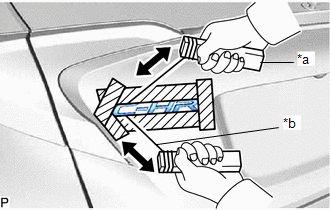
|
*a |
Wooden Block |
|
*b |
Piano Wire |
.png) |
Protective Tape |
(b) Insert a piano wire between the back door outside garnish and No. 2 back door name plate.
(c) Tie objects that can serve as handles (for example, wooden blocks) to both wire ends.
(d) Pull the piano wire and cut the double-sided tape that holds the No. 2 back door name plate to the back door outside garnish to remove the No. 2 back door name plate.
NOTICE:
Be careful not to damage the back door outside garnish.
(e) Remove the protective tape.
2. REMOVE NO. 1 BACK DOOR NAME PLATE
(a) Apply protective tape around the No. 1 back door name plate as shown in the illustration.
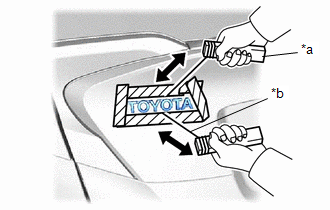
|
*a |
Wooden Block |
|
*b |
Piano Wire |
|
|
Protective Tape |
(b) Insert a piano wire between the back door outside garnish and No. 1 back door name plate.
(c) Tie objects that can serve as handles (for example, wooden blocks) to both wire ends.
(d) Pull the piano wire and cut the double-sided tape that holds the No. 1 back door name plate to the back door outside garnish to remove the No. 1 back door name plate.
NOTICE:
Be careful not to damage the back door outside garnish.
(e) Remove the protective tape.
3. REMOVE NO. 1 BACK DOOR EMBLEM
(a) Apply protective tape around the No. 1 back door emblem as shown in the illustration.
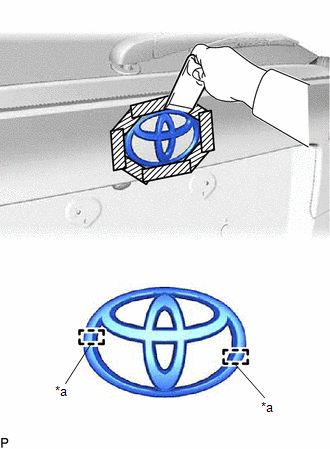
|
*a |
Location Pin |
|
|
Protective Tape |
(b) Using a moulding remover D, separate the double-sided tape and disengage the pins to remove the back door ornament sub-assembly.
NOTICE:
Be careful not to damage the back door outside garnish.
(c) Remove the protective tape.
 Components
COMPONENTS
ILLUSTRATION
*1
NO. 1 BACK DOOR EMBLEM
*2
NO. 1 BACK DOOR NAME PLATE
*3
NO. 2 BACK DOOR NAME PLATE
-
...
 Installation
INSTALLATION
CAUTION / NOTICE / HINT
HINT:
When installing the name plates, heat the back door outside garnish and name
plates using a heat light.
Heating Temperature
Item
...
Other materials:
Toyota CH-R Service Manual > Front Suspension System: Problem Symptoms Table
PROBLEM SYMPTOMS TABLE
HINT:
Use the table below to help determine the cause of problem symptoms. If multiple
suspected areas are listed, the potential causes of the symptoms are listed in order
of probability in the "Suspected Area" column of the table. Check each symptom by
check ...
Toyota CH-R Service Manual > Rear View Monitor System: Problem Symptoms Table
PROBLEM SYMPTOMS TABLE
HINT:
Use the table below to help determine the cause of problem symptoms.
If multiple suspected areas are listed, the potential causes of the symptoms
are listed in order of probability in the "Suspected Area" column of the
table. Check each sy ...
Toyota C-HR (AX20) 2023-2026 Owner's Manual
Toyota CH-R Owners Manual
- For safety and security
- Instrument cluster
- Operation of each component
- Driving
- Interior features
- Maintenance and care
- When trouble arises
- Vehicle specifications
- For owners
Toyota CH-R Service Manual
- Introduction
- Maintenance
- Audio / Video
- Cellular Communication
- Navigation / Multi Info Display
- Park Assist / Monitoring
- Brake (front)
- Brake (rear)
- Brake Control / Dynamic Control Systems
- Brake System (other)
- Parking Brake
- Axle And Differential
- Drive Shaft / Propeller Shaft
- K114 Cvt
- 3zr-fae Battery / Charging
- Networking
- Power Distribution
- Power Assist Systems
- Steering Column
- Steering Gear / Linkage
- Alignment / Handling Diagnosis
- Front Suspension
- Rear Suspension
- Tire / Wheel
- Tire Pressure Monitoring
- Door / Hatch
- Exterior Panels / Trim
- Horn
- Lighting (ext)
- Mirror (ext)
- Window / Glass
- Wiper / Washer
- Door Lock
- Heating / Air Conditioning
- Interior Panels / Trim
- Lighting (int)
- Meter / Gauge / Display
- Mirror (int)
- Power Outlets (int)
- Pre-collision
- Seat
- Seat Belt
- Supplemental Restraint Systems
- Theft Deterrent / Keyless Entry

0.009