
Toyota CH-R Service Manual: Steering Angle Sensor
Components
COMPONENTS
ILLUSTRATION
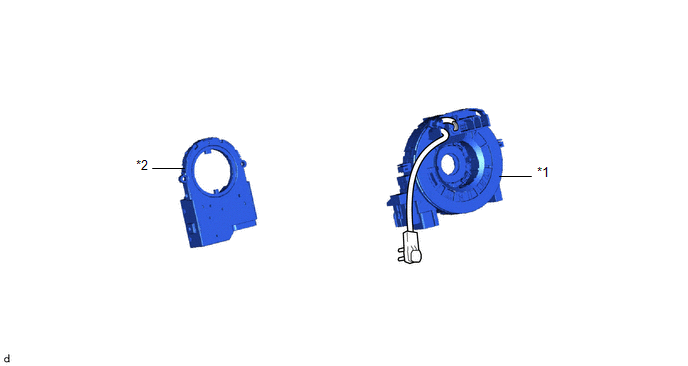
|
*1 |
SPIRAL CABLE SUB-ASSEMBLY |
*2 |
STEERING SENSOR |
Removal
REMOVAL
CAUTION / NOTICE / HINT
The necessary procedures (adjustment, calibration, initialization, or registration) that must be performed after parts are removed, installed, or replaced during the spiral cable with sensor sub-assembly removal/installation are shown below.
Necessary Procedure After Parts Removed/Installed/Replaced|
Replacement Part or Procedure |
Necessary Procedures |
Effects / Inoperative when not performed |
Link |
|---|---|---|---|
|
Disconnect cable from negative battery terminal |
Memorize steering angle neutral point |
Lane departure alert system (w/ Steering Control) |
|
|
Pre-collision system |
|||
|
Initialize back door lock |
Power door lock control system |
|
HINT:
- Use the same procedure for RHD and LHD vehicles.
- The following procedure is for LHD vehicles.
PROCEDURE
1. REMOVE SPIRAL CABLE WITH SENSOR SUB-ASSEMBLY
Click here
.gif)
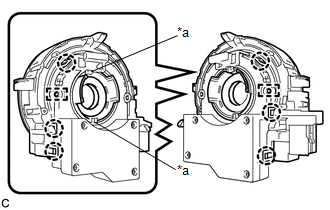
2. REMOVE STEERING SENSOR
|
(a) Disengage the claws and pins, and remove the spiral cable sub-assembly from the steering sensor. NOTICE: Do not damage the pins of the spiral cable sub-assembly or guides of the steering sensor. |
|
Installation
INSTALLATION
CAUTION / NOTICE / HINT
HINT:
- Use the same procedure for RHD and LHD vehicles.
- The following procedure is for LHD vehicles.
PROCEDURE
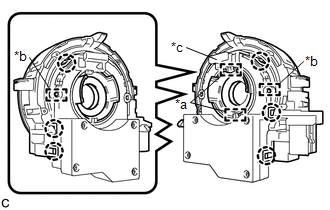
1. INSTALL STEERING SENSOR
|
(a) Align the pins and guides, and engage the claws to install the steering sensor to the spiral cable sub-assembly. NOTICE:
|
|
|
(b) Remove the lock pin from the steering sensor. |
|
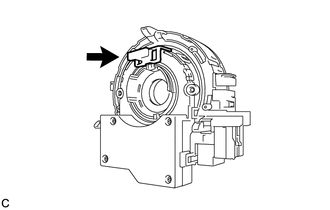
2. INSTALL SPIRAL CABLE WITH SENSOR SUB-ASSEMBLY
Click here
.gif)
 Rear Speed Sensor
Components
COMPONENTS
ILLUSTRATION
*1
REAR AXLE HUB AND BEARING ASSEMBLY
*2
REAR DISC
*3
REAR DISC BRAKE CALIPER ASSEMBLY ...

Other materials:
Toyota CH-R Service Manual > Power Steering Ecu: Installation
INSTALLATION
PROCEDURE
1. INSTALL ELECTRIC POWER STEERING MOTOR SHAFT DAMPER
Grease
(a) Apply grease to a new electric power steering motor shaft damper.
NOTICE:
First wipe off the existing grease from the serrated part, and then apply the
dedicated grease supp ...
Toyota CH-R Service Manual > Continuously Variable Transaxle System: Parts Location
PARTS LOCATION
ILLUSTRATION
*1
ECM
*2
SKID CONTROL ECU (BRAKE ACTUATOR ASSEMBLY)
*3
NO. 1 ENGINE ROOM RELAY BLOCK
- EFI-MAIN NO. 1 RELAY
- EFI-MAIN NO. 1 FUSE
- EFI NO. 2 FUSE
- ECU-IG2 NO. 1 FUSE
- ECU-B NO. ...
Toyota C-HR (AX20) 2023-2026 Owner's Manual
Toyota CH-R Owners Manual
- For safety and security
- Instrument cluster
- Operation of each component
- Driving
- Interior features
- Maintenance and care
- When trouble arises
- Vehicle specifications
- For owners
Toyota CH-R Service Manual
- Introduction
- Maintenance
- Audio / Video
- Cellular Communication
- Navigation / Multi Info Display
- Park Assist / Monitoring
- Brake (front)
- Brake (rear)
- Brake Control / Dynamic Control Systems
- Brake System (other)
- Parking Brake
- Axle And Differential
- Drive Shaft / Propeller Shaft
- K114 Cvt
- 3zr-fae Battery / Charging
- Networking
- Power Distribution
- Power Assist Systems
- Steering Column
- Steering Gear / Linkage
- Alignment / Handling Diagnosis
- Front Suspension
- Rear Suspension
- Tire / Wheel
- Tire Pressure Monitoring
- Door / Hatch
- Exterior Panels / Trim
- Horn
- Lighting (ext)
- Mirror (ext)
- Window / Glass
- Wiper / Washer
- Door Lock
- Heating / Air Conditioning
- Interior Panels / Trim
- Lighting (int)
- Meter / Gauge / Display
- Mirror (int)
- Power Outlets (int)
- Pre-collision
- Seat
- Seat Belt
- Supplemental Restraint Systems
- Theft Deterrent / Keyless Entry

0.0085